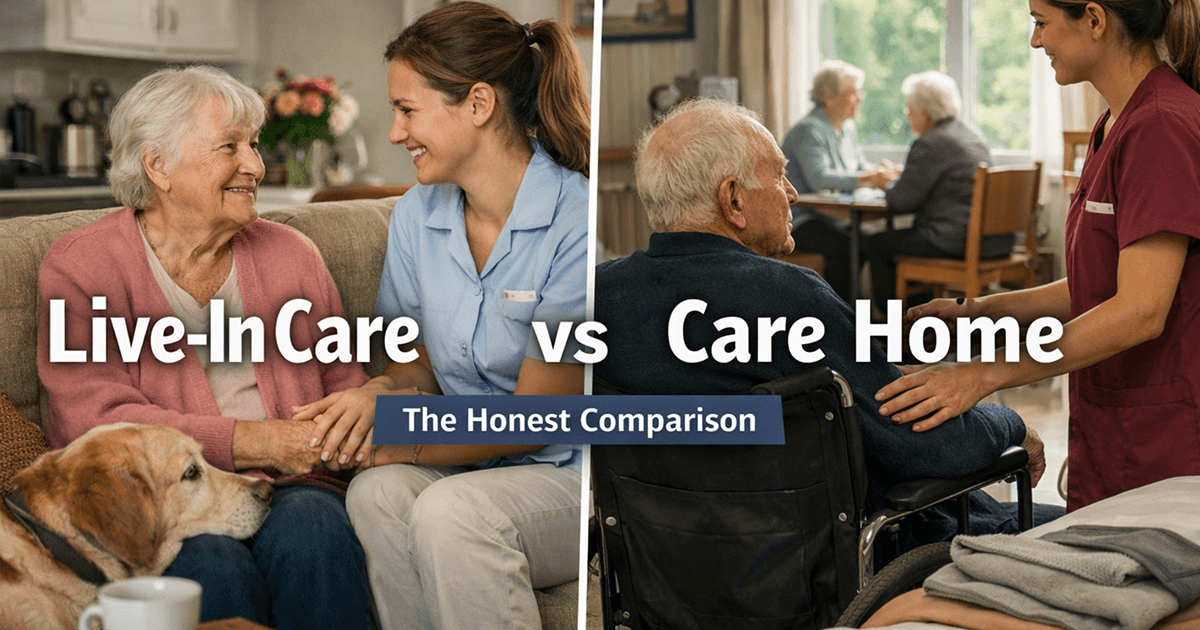
For a single person, a care home is usually cheaper: a residential care home costs roughly £47,000 per year versus live-in care at approximately £79,000 (including food, utilities, and respite cover). For couples, live-in care is often the better deal: one carer for two people costs around £83,000 per year versus two care home places at £94,000. But cost is only one factor — safety, nursing needs, social interaction, and the person's own preference all matter. Cost figures are based on UKHCA and LaingBuisson market data for 2025-2026.
This guide gives you the honest comparison that most websites cannot, because most websites selling either live-in care or care home places have a financial interest in the answer. We do not sell either. We help families find the right care — wherever that is.
This guide covers England only. Scotland, Wales, and Northern Ireland have different care funding systems.
Last updated: March 2026.
The Cost Comparison (With Real Numbers)
Most comparison articles quote weekly fees. That is misleading because live-in care has significant additional costs that care homes do not. Here is the full picture.
| Factor | Live-in care (single) | Residential care home | Nursing home |
|---|---|---|---|
| Base weekly fee | £1,350 | £900 | £1,200 |
| Food and utilities | Included in total below | Included | Included |
| Respite cover per year | ~£4,000 | N/A | N/A |
| Annual total | ~£79,200 | ~£46,800 | ~£62,400 |
For a single person, the gap is clear: a residential care home is £32,000 per year cheaper than live-in care. A nursing home is £17,000 cheaper.
The couples calculation
This is where the comparison flips.
| Live-in care (couple) | Two care home places | |
|---|---|---|
| Weekly cost | £1,400-1,600 | £1,800 (2 x £900) |
| Annual cost | ~£83,000 | ~£93,600 |
| Annual saving | £10,000-£30,000 | — |
One carer supporting two people in their own home is significantly cheaper than paying for two separate care home places. For couples, the financial case for live-in care is strong.
For a detailed breakdown of all live-in care costs — including the hidden expenses that agencies rarely mention upfront — see our cost guide.
The property factor
There is one more financial difference that does not appear in the cost tables but can be worth more than all of them combined.
When someone receives care at home — whether visiting care or live-in care — their property is not counted in the council's financial means test. When someone moves into a care home, the property is usually included in the assessment after 12 weeks (unless a spouse, dependent relative, or qualifying person still lives there).
For a family whose main asset is a house worth £300,000, this distinction can determine whether the council funds the care or whether the family pays the full cost. It is one of the most significant financial factors in the entire decision.
Beyond Cost: 8 Factors That Actually Decide
Cost matters, but it rarely settles the question on its own. These eight factors are what families tell us actually tipped their decision.
1. Safety and supervision
Live-in care: One carer, usually sleeping at night. If the person falls at 3am, the carer may or may not wake. Door sensors and monitors help, but a single person cannot provide the same level of oversight as a team.
Care home: Staff on duty 24 hours, including waking night staff. Call bells in every room. Someone is always awake and available.
Better for falls risk, wandering, or unpredictable behaviour: Care home.
2. Nursing and medical needs
Live-in carer: Not a nurse. Cannot administer injections, manage wounds, adjust medication dosages, or handle clinical equipment. If nursing tasks are needed, a district nurse visits separately — but this is not on-demand.
Nursing home: Qualified nurse on duty 24 hours. Clinical care is immediate and integrated.
Better for nursing needs: Nursing home, clearly.
3. Dementia stage
Early to mid-stage dementia: Live-in care has a real clinical advantage. Familiar surroundings reduce confusion, agitation, and sundowning. The person keeps their routine, their belongings, and their sense of "home." Research consistently shows that relocation accelerates cognitive decline in dementia — NICE guideline NG97 recommends supporting people with dementia to remain in familiar environments wherever possible.
Advanced dementia (wandering, aggression, loss of recognition): A specialist dementia care home with a secure unit is usually safer and more sustainable. One carer alone cannot safely manage persistent wandering or aggressive behaviour.
For a detailed guide to live-in dementia care — including costs and when to transition — see our specialist guide.
4. Social life and loneliness
Live-in care: The person has 1:1 companionship with their carer plus family visits. But if friends have died or moved away, and the person is housebound, the carer may be their only daily human contact.
Care home: Other residents, communal meals, an activities programme, and daily social interaction without anyone needing to arrange it.
Better for someone who is isolated: Care home. The built-in community is one of the strongest arguments for residential care, and it is the one families most often underestimate.
5. Independence and routine
Live-in care: Own home, own bed, own food, own schedule. The person decides when to wake, what to eat, when to go to bed. The carer adapts to them.
Care home: Institutional routine. Meal times are fixed. Shared spaces have shared rules. Personal choice exists but within a framework designed around the group.
Better for someone who values independence: Live-in care, clearly.
6. Property and financial implications
As described above, the property exemption for care at home is a major financial advantage. For many families, particularly those with modest savings but a valuable home, this is the deciding factor.
Better for preserving the family home: Live-in care.
7. Staff continuity
Live-in care: Usually one main carer who builds a deep relationship with the person. This is a significant advantage — familiarity, trust, and understanding develop over weeks and months. The risk: if that carer leaves, falls ill, or burns out, the transition to a new carer can be deeply unsettling.
Care home: Rotating staff. Less personal, but more resilient. If one staff member leaves, the system continues. The person is cared for by a team rather than depending on a single individual.
8. Family peace of mind
This is subjective, but it matters.
Some families feel most at peace knowing their parent is "at home, being looked after." The emotional comfort of keeping someone in familiar surroundings is real and should not be dismissed.
Other families feel most at peace knowing there is a professional team, 24-hour cover, and immediate access to help if something goes wrong. The safety comfort of a care home is equally real.
Neither feeling is wrong. Both are valid.
Decision Framework: 5 Questions to Settle It
If you are going in circles, these five questions usually resolve the decision.
1. Does the person need nursing care? If yes — a nursing home. A live-in carer cannot provide clinical care, and relying on visiting district nurses for regular medical needs is not sustainable.
2. Is wandering or aggression a risk? If yes — a care home with a secure unit. One carer alone cannot safely manage persistent wandering or physically challenging behaviour. This is a safety issue, not a preference.
3. Are they a couple? If yes — live-in care has a strong financial case. One carer for two people is significantly cheaper than two care home places, and both people stay in their own home.
4. Is social isolation a concern? If the person is lonely, housebound, and their main social contact would be a single carer — a care home's built-in community may be more beneficial than staying at home. Loneliness is a genuine health risk, particularly in older age.
5. Is preserving the home the priority? If yes — live-in care keeps the property out of the means test. If the family home is the main financial asset and protecting it matters, this advantage is substantial.
If you answered "yes" to questions 1 or 2, a care home is almost certainly the right answer regardless of other factors. If you answered "yes" to 3 or 5, live-in care has the advantage. Question 4 is a judgement call that only the family can make.
The Hybrid Option Most Families Miss
The decision does not have to be permanent, and it does not have to be all-or-nothing.
Many families start with live-in care — keeping the person at home in familiar surroundings while their needs are manageable. As needs increase, they use respite stays in a care home to test whether residential care might work. If it does, the transition happens gradually and with evidence rather than in a crisis.
This approach has three advantages:
Financially: The property remains exempt from the means test for as long as the person lives at home. Transitioning later means the family has more time to plan.
Emotionally: The person is not uprooted suddenly. Respite stays introduce the idea of a care home gently.
Practically: You learn what kind of care home suits the person by testing it, rather than guessing from a brochure.
The risk is waiting too long. If the person's needs escalate suddenly — a fall, a stroke, advanced dementia — an emergency admission to whatever care home has a bed is far worse than a planned transition to a home you have already tested.
If a Care Home Is the Right Choice
The decision to move to a care home is hard enough. Do not add the stress of choosing the wrong one.
What to look for:
- CQC ratings — but look beyond the headline. A home rated "Good" overall may have "Requires Improvement" in specific domains that matter for your parent. See our guide to what CQC ratings actually mean.
- Specialist expertise — if dementia care is needed, check whether the home has a dedicated dementia unit with trained staff, not just a general ward.
- Staff ratios and turnover — high staff turnover is one of the strongest predictors of poor care quality.
- Location — close enough for regular family visits. A beautiful home two hours away that nobody visits is worse than a decent home ten minutes away.
A Critical Edge (The MSIF Benchmark): If you decide that a care home is the right next step, do not just accept the first price you are quoted in a brochure. RightCareHome has analyzed the Market Sustainability and Improvement Fund (MSIF) data—the exact rates local councils pay these same homes. Families are routinely quoted 30-40% more than the council rate for the identical room. Knowing the fair local rate is your strongest negotiating tool, saving you thousands during the transition.
For a full comparison methodology, see our data-driven framework for comparing care homes. To verify a care home's claims before committing, see our verification checklist.
Our Funding Calculator matches you to care homes based on 156 data-backed quality factors, calculates your true funding position, and pulls the correct MSIF data for your local authority.
Get Your Custom Funding Action Plan
Funding: The Same Rules Apply to Both
Whether you choose live-in care or a care home, the funding landscape is the same. The thresholds below are set by the Care Act 2014 and updated annually by GOV.UK:
- Above £23,250 in assets: You pay the full cost yourself (self-funding)
- Between £14,250 and £23,250: The council contributes, and you pay a tariff income
- Below £14,250: The council pays in full
The one crucial difference: your property is not counted while you live in it. This means someone receiving live-in care with £20,000 in savings and a £300,000 house is assessed on £20,000 — qualifying for council support. The same person in a care home is assessed on £320,000 — paying the full cost.
For a personalised breakdown of every funding route available to you, our Funding Calculator covers Attendance Allowance, NHS Continuing Healthcare, council funding, and benefits in one report.
Get Your Custom Funding Action Plan
When to Switch from Live-In Care to a Care Home
Even when live-in care is working well, these situations signal it may no longer be safe or practical:
- Two carers are needed for moving and handling — the cost exceeds a care home and staffing becomes unreliable
- Persistent wandering that bypasses door sensors and stair gates — one carer cannot physically prevent someone leaving the house
- Nightly disturbance requiring waking night care — at £1,700+ per week, costs escalate and a single carer cannot sustain this long-term
- Repeated carer turnover — if you are on your third or fourth carer in a year, the instability is harmful and the arrangement is not working
- Nursing needs have emerged — a live-in carer is not a nurse, and relying on visiting district nurses for regular clinical tasks is not sustainable
Worked Scenario: The Tipping Point
To understand when the financial and practical math breaks down, let's look at the exact moment a family must transition.
The Situation: Evelyn (86) has lived at home with a live-in carer for two years. The arrangement costs £1,350/week. Recently, her mobility has severely declined. After a hospital stay, the occupational therapist states Evelyn now requires hoisting for all transfers (bed to chair, chair to toilet).
The Impact on Live-In Care: By law, operating a hoist requires two trained people. A single live-in carer cannot do this alone. The family has two options to keep Evelyn at home:
- Hire a second live-in carer (Cost: £2,700/week)
- Pay a visiting care agency to send a second carer just for the 4 transfer times each day (Cost: £1,350 base + 28 hours visiting care at £30/hr = £2,190/week)
The Care Home Alternative: The family checks local nursing homes. Because nursing homes have multiple staff on shift at all times, two-person hoist transfers are part of the standard daily routine. A good local nursing home quotes £1,400/week.
The Verdict: At this specific "tipping point" (the need for two-person transfers), staying at home jumps from £1,350 to £2,190+ per week, while a nursing home costs £1,400. The family transitions Evelyn to the nursing home, ensuring safe transfers while saving nearly £40,000 a year compared to the enhanced home care package.
Sources
- UKHCA — United Kingdom Homecare Association — home care cost benchmarks
- LaingBuisson — care market data and fee analysis
- Care Act 2014 — funding thresholds and local authority duties
- NICE guideline NG97 — Dementia: assessment, management and support — care environment recommendations