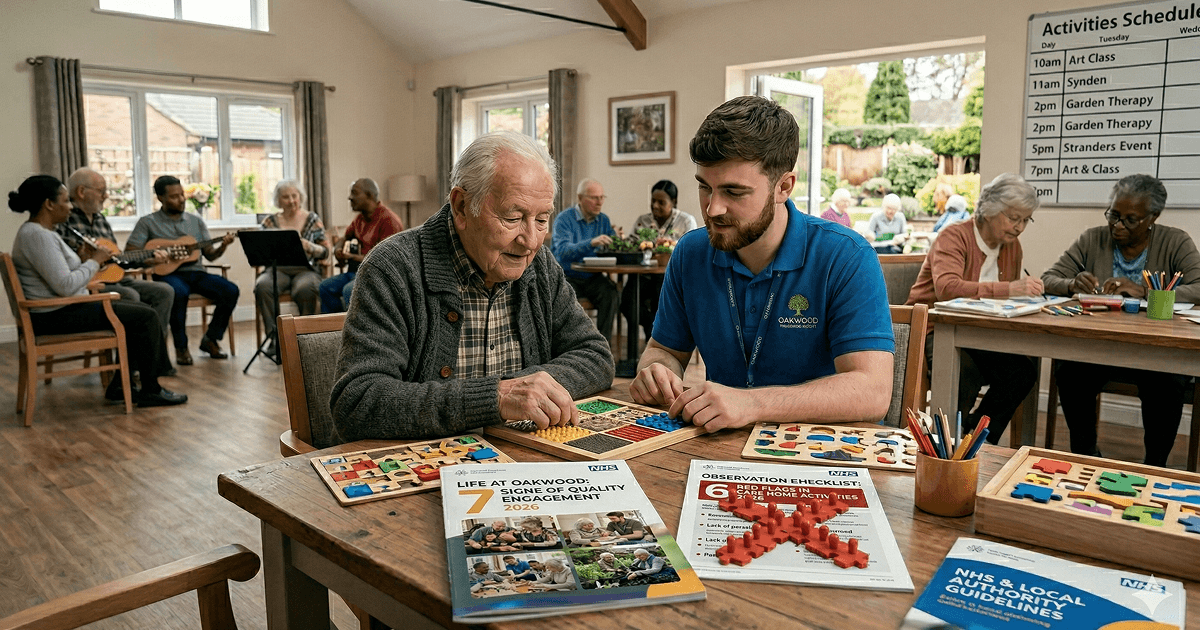
A care home's activities programme reveals more about its culture than almost anything else. A home that invests in genuinely engaging residents — with personalised, varied, and dignified activities — is a home that sees its residents as people. A home where the television is the default entertainment is a home that has stopped trying.
This guide is not a list of activity ideas for care home staff. It is a quality evaluation framework for families: 7 signs that a care home's activities programme is genuinely good, red flags that reveal a tick-box culture, and the specific questions to ask when you visit.
This guide covers England only. Scotland, Wales, and Northern Ireland have different care systems.
Last updated: March 2026.
Why Activities Matter More Than You Think
Activities are not a nice extra. They are a core part of care.
CQC evaluates activities under the "Responsive" domain of its inspection framework. A home that neglects activities will struggle to achieve "Good" in this domain. When reading a CQC report, look for specific comments about the activities programme, resident engagement, and whether activities are tailored to individuals.
Research is clear. Meaningful activity reduces depression, agitation, and the use of antipsychotic medication in care home residents. It improves sleep, appetite, and social engagement. For people with dementia, structured activity slows behavioural decline and reduces the frequency of distressed episodes.
Activities reveal staff culture. A home with a thoughtful, well-resourced activities programme is signalling something broader: that it employs people who care about quality of life, not just safety. A home where staff have time and training for activities is a home that manages its staffing and budget well.
The warning: A "good" activities programme on paper means nothing if residents are sitting in a lounge watching television all day. The schedule on the wall and the reality in the room are sometimes very different things. This is why visiting at different times — including unannounced — matters.
7 Signs of a Meaningful Activities Programme
1. Personalised, not one-size-fits-all
The best care homes use life story work to understand each resident's history, interests, career, hobbies, and personality. Activities are then tailored to the individual.
An ex-gardener should be offered potting and planting, not just bingo. A retired teacher might enjoy reading groups or helping with word puzzles. A former musician should have access to their instrument or to music that means something to them — not just background radio.
What to look for: Ask the home: "How do you find out what each resident enjoys?" A good answer involves a life story document, conversations with the family, and observation of what the person responds to. A poor answer is: "We have a programme that everyone joins."
2. Variety across four dimensions
A strong activities programme covers four types of engagement. If any is missing, the programme is incomplete.
| Dimension | Good examples | Red flag |
|---|---|---|
| Physical | Chair yoga, walking groups, seated dance, ball games, gardening | Nothing beyond sitting |
| Creative | Art classes, music-making, crafts, cooking, flower arranging | Colouring sheets as the only creative option |
| Cognitive | Quizzes, reading groups, reminiscence, puzzles, word games | Television left on as the default |
| Social | Outings, intergenerational visits, parties, communal meals, pen pals | No communal activities at all |
A care home that offers bingo, a film afternoon, and a monthly singer covers social and cognitive — but misses physical and creative entirely. Look for breadth.
3. Outdoor time and community connection
Being outdoors matters. Fresh air, natural light, and a change of environment improve mood, sleep, and physical health. A good care home provides:
- Garden access — a safe, accessible outdoor space that residents can use freely (not locked unless there is a genuine safety reason)
- Regular outings — trips to local shops, cafes, parks, or places of interest. A minibus or transport arrangement that makes this practical
- Community links — visits from local school children, Brownie or Scout groups, community choirs, or therapy animals. These bring the outside world in
Red flag: If residents never leave the building — not for walks, not for outings, not even into the garden — the home has made a choice about effort that tells you something.
4. Dementia-adapted activities
For people with dementia, standard activities may not work. Good dementia care homes offer activities specifically designed for cognitive impairment:
Namaste care — a gentle, sensory-based approach for people with advanced dementia. NICE guideline NG97 recommends tailored activities as a core part of dementia care. Involves soft music, gentle touch, aromatherapy, and calm conversation. It provides comfort and connection for people who can no longer participate in conventional activities.
Music therapy — not just playing music, but using songs from the person's era to trigger memories, emotions, and responses. The Alzheimer's Society recommends music as one of the most effective activities for people with dementia. Music is one of the last cognitive abilities to fade in dementia, and its therapeutic value is well-evidenced.
Reminiscence — using photographs, objects, and stories from the past to stimulate memory and conversation. A box of items from the 1950s, a photograph album from the local area, or a discussion about a well-known historical event.
Sensory stimulation — textured objects, scented items, coloured lights, water features. For people in advanced stages of dementia, sensory input provides comfort when verbal communication is no longer possible.
Simple structured tasks — folding towels, sorting buttons, polishing silverware. These provide a sense of purpose and occupation without requiring complex planning or memory.
What to look for: Ask: "How do you adapt activities for residents with advanced dementia?" If the answer is "we do the same activities, just at a slower pace," the home does not understand dementia care.
5. A dedicated activities coordinator
This is one of the most reliable signals of quality.
A dedicated activities coordinator — someone whose full-time or primary role is planning and running activities — means the home has invested in engagement as a distinct function, not an afterthought.
Red flag: "Care staff run activities when they have time." This means activities happen when staffing allows, which in practice means rarely. Care workers are busy with personal care, medication rounds, and documentation. Activities are the first thing dropped when time is short.
What to ask: "Do you have a full-time activities coordinator? What are their qualifications? How many hours per week do they work?" Some homes have a coordinator who works only 15 hours — covering Monday to Wednesday mornings — leaving residents with nothing for the rest of the week.
6. A visible and current weekly programme
Good care homes display the activities schedule prominently — in the entrance, in communal areas, and sometimes in residents' rooms. The schedule should be current (this week's, not a generic template) and show specific activities on specific days and times.
What to check: Look at the displayed programme. Is it dated? Does it show specific activities or generic placeholders like "morning activity"? Then ask a resident or their family member: "Did yesterday's activities actually happen?" The gap between the schedule and reality is where quality falls away.
7. Choice and dignity
Residents must be able to choose whether to participate. Activity should be offered, encouraged, and made accessible — but never forced or pressured. A resident who prefers to read quietly in their room is exercising choice, not being neglected.
Good homes also offer activities throughout the day — not just in a concentrated 2-4pm slot. Morning, afternoon, and evening engagement should all be available, recognising that people have different energy levels at different times.
Red Flags to Watch for During a Visit
When you visit a care home — whether a planned tour or an unannounced drop-in — these signals suggest the activities programme is weak:
- Television on in the lounge with residents sitting silently. This is the single clearest sign. If the TV is the main source of stimulation, the home is not engaging its residents
- No visible activities schedule. If you cannot find a displayed programme on the wall, the home does not prioritise it
- Staff cannot name the activities coordinator. If care workers do not know who runs activities, the role is invisible within the home
- "We do bingo on Tuesdays" as the only specific answer. One activity per week is not a programme
- No outdoor space or garden access. If there is no accessible outdoor area, residents are confined indoors permanently
- Activities stop at weekends. If the activities coordinator only works weekdays, two days out of seven have nothing
Worked Scenario: The Illusion of Activities
To understand how easily a home can look active on paper while failing in practice, let's look at a common scenario.
The Situation: You visit "Cedar Manor." The manager hands you a beautifully printed, full-colour weekly activities schedule. It lists "Armchair Zumba" at 10 AM, "Baking Club" at 2 PM, and "Film Matinee" at 4 PM every day. It looks incredibly vibrant.
The Hidden Reality (Visible during an unannounced visit): You return unannounced on Thursday at 2:15 PM, expecting to see the Baking Club in full swing.
- You walk into the main lounge. Fifteen residents are sitting in a circle around the edge of the room.
- The TV is blaring a daytime soap opera. Most residents are asleep or staring blankly.
- A single care worker is standing in the corner, hurriedly filling out paperwork on a clipboard.
- You ask where the Baking Club is. The carer looks confused, then says: "Oh, the activities coordinator called in sick today, so we just put a film on."
The Lesson: A printed schedule means nothing if it relies on a single part-time staff member who is never covered when absent. Genuine quality means activities are embedded in the culture of the whole care team, not just an isolated "event" that gets cancelled the moment staffing is tight.
Questions to Ask About Activities
When visiting or shortlisting a care home, these questions reveal the quality of the activities programme more effectively than a brochure:
"What did residents do yesterday?" This tests reality, not aspiration. If the answer is vague, the day was probably uneventful.
"Can I see the activities schedule for last week?" Last week's schedule is harder to fabricate than next week's plan. Look for variety and specificity.
"How do you adapt activities for residents with dementia?" This separates homes with genuine dementia expertise from those that treat it as an afterthought.
"Do you offer one-to-one activities for residents who cannot join groups?" Some residents cannot or choose not to participate in group activities. A good home engages them individually.
"How often do residents go outside?" Daily garden access should be standard. Regular outings should be planned. If the answer involves caveats about weather, staffing, or "when possible," access is not prioritised.
"Is the activities coordinator here today? Can I meet them?" Meeting the person responsible tells you a lot. Their enthusiasm, knowledge of individual residents, and ability to describe what they do reveals the quality of the programme instantly.
For a complete list of questions to ask during a visit, see our guide to questions to ask when visiting a care home.
How We Evaluate Activities
When matching families to care homes, we look beyond CQC headline ratings to evaluate the quality of engagement and daily life.
Our matching considers CQC "Responsive" domain ratings, specific inspector comments about activities and engagement, and evidence of specialist programmes (dementia activities, end-of-life engagement, intergenerational projects).
A home rated "Good" overall but with CQC comments highlighting meaningful, personalised activities is a different proposition from a home rated "Good" with no mention of activities at all.
Our Funding Calculator identifies care homes based on 156 quality factors — including engagement, CQC "Responsive" domains, and specific inspector comments.
A Critical Edge (The MSIF Benchmark): If a care home charges £1,500+ a week but you observe the "red flags" (TV on all day, no dedicated activities staff, no weekend programme), be very careful. You are paying a premium for basic warehousing. RightCareHome publishes the Market Sustainability and Improvement Fund (MSIF) data—the official council rates. If your council pays £950/week for that same home, you know they are operating a £950-level activities budget while charging you a premium. Knowing the MSIF rate is your strongest negotiating tool to either demand better service or challenge unjustified fees.
Get Your Custom Funding Action Plan
For a deeper understanding of what CQC ratings reveal (and what they miss), see our guide to what CQC ratings actually mean and our article on hidden quality indicators beyond CQC.
Good Sign vs Red Flag: What to Watch for During a Visit
| What you observe | Good sign | Red flag |
|---|---|---|
| Lounge atmosphere | Residents engaged in small group activities | All residents watching TV in silence |
| Staff involvement | Carer sitting with a resident doing a puzzle together | Staff gathered at the nurses' station, residents unoccupied |
| Activities board | Dated this week, specific activities with times | Generic template, undated, or missing entirely |
| Outdoor space | Residents in the garden with staff nearby | Garden locked or inaccessible |
| Individual engagement | A carer doing one-to-one reminiscence with a resident | Residents left alone in their rooms with no interaction |
Sources
- CQC Regulation 9: Person-Centred Care — CQC's guidance on how activities are assessed under the Responsive domain
- NICE Guideline NG97: Dementia — Assessment, Management and Support — national recommendations for dementia activities and meaningful occupation
- Alzheimer's Society: Activities for People with Dementia — practical guidance on activities that work for people at different stages of dementia